
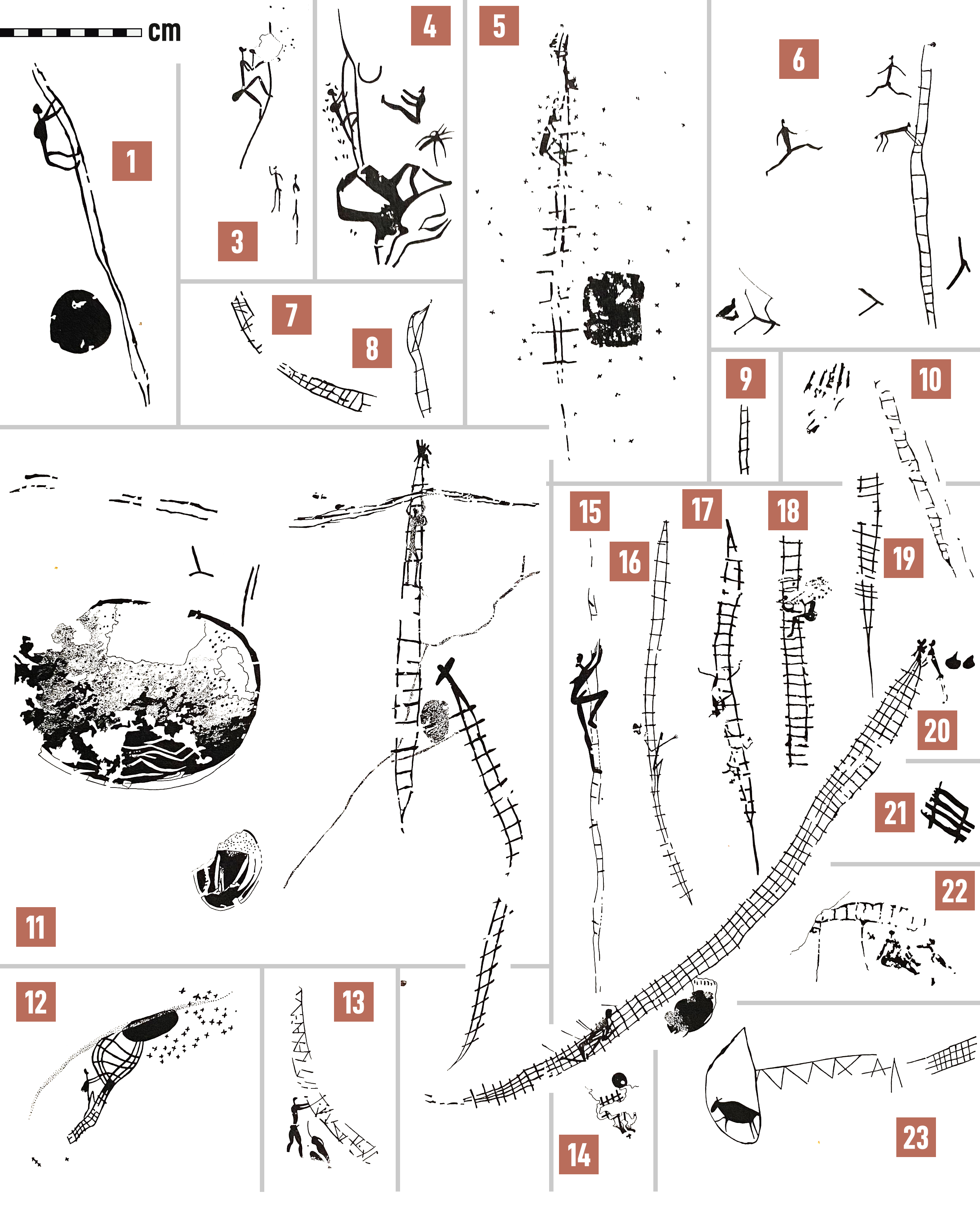
Pager’s (1971, 350) redrawings of the Cathedral ladders and climbing ropes and the Boschman’s Klip climbing rope, which is outside the uKhahlamba-Drakensberg (Figure 2). Drawing no. 2 has been removed as it is an example from Spain. 1. Ladder Shelter; 3. Boschman’s Klip (also known as Vimy Ridge); 4. Junction Shelter; 5. Fish Shelter; 6. Whitecliff; 7. eSibayeni Cave (also known as Sebaaieni Cave); 8. Junction Shelter; 9. van der Riet Shelter; 10. eSibayeni Cave; 11. Ladder Shelter; 12. Eland Cave; 13. eSibayeni Cave; 14. Botha’s Shelter; 15. Ladder Shelter; 16. Cleft Shelter (also known as Cliff Path Shelter); 17. Fish Shelter; 18. Ladder Rock; 19. Eland Cave; 20. Ladder Shelter; 21. Sorcerer’s Rock; 22. eSikolweni Shelter; 23. Pit-fall Shelter.
As Lewis-Williams and Dowson (2000, 116) proposed for bows, arrows, bags and digging sticks, I suggest that paintings of ladders and climbing ropes represented ‘ordinary items of equipment’ with ‘more to them than meets the eye’. I further suggest that this imagery was deeply embedded in hunter-gatherer belief systems and represented entoptic phenomena (i.e., visual patterns generated by the brain in trance) experienced in altered states of consciousness. The symbolic potency of these images may have been enhanced through their association with connections between the earth and sky as giraffes, tall trees and termite hills were believed to do. This is known from ethnographic studies among hunter-gatherers.
Moreover, the role that the items played in obtaining honey could be seen as akin to eland-hunting in the attainment of ‘very strong potency’ (Mguni 2015, 55). Achieving this potency involved hunter-gatherers interacted with bees, another powerful symbol of potency, especially as the buzzing of bees would have resonated with what medicine people experienced in trance.
Consistent with their status as ‘ordinary items of equipment’, ladder-like structures are known in the hunter-gatherer ethnographic literature. Although different from those represented in the paintings, they demonstrate that this concept was familiar to the hunter-gatherers. The Hadza (Marlowe 2010) and the San (Stow 1905), for example, used ladder-like structures comprising pegs in trees. The San also had what Stow (1905, 87) referred to as a ‘kind of rude ladder formed of sharpened pegs of hard wood driven into the cracks and crevices in the face of the precipice … that they not only ascended without the least hesitation or symptom of fear, but also with a rapidity that was perfectly astonishing’.
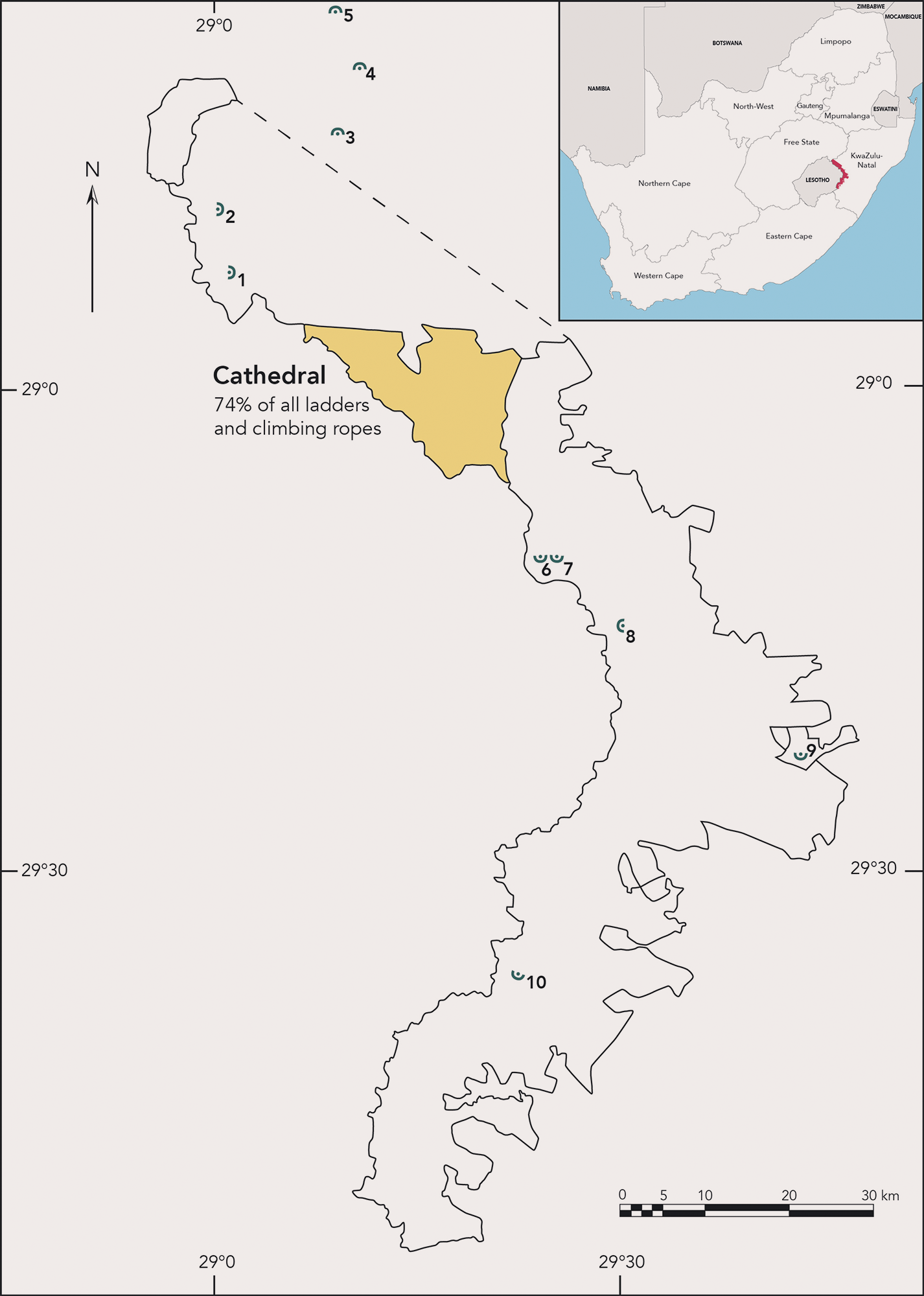
Distribution of ladders and climbing ropes in the uKhahlamba-Drakensberg and adjacent areas. The sites within Cathedral are Anchor Shelter, Ladder Shelter, Junction Shelter, Fish Shelter, Whitecliff, van der Riet Shelter, eSibayeni Cave, Eland Cave, Botha’s Shelter, Cleft Shelter, Ladder Rock, Sorcerer’s Rock, eSikolweni Shelter and Pit-fall Shelter. Outside Cathedral, the sites are 1. uBebe Shelter; 2. eBusingatha Shelter; 3. Tugela Shelter; 4. Boschman’s Klip; 5. Farm Rangeworthy; 6. Lower Injasuthi Cave; 7. Battle Cave; 8. Main Caves North; 9. Christmas Shelter; 10. Emerald Shelter. Inset map shows the location of uKhahlamba-Drakensberg within South and southern Africa.
Pager (1971) saw a ladder constructed from wooden poles and grass rope in Cathedral Peak (hereafter Cathedral; Figure 2) that went to a beehive. Although he thought it was likely used by Africans, we do not know when it was made and who made it. In the early 1980s, Adrian Koopman told me about a rope ladder north of Cathedral, but unfortunately, I did not visit it. Notably, rope ladders are still used for collecting honey in, for example, Nepal and India. Lastly, the hunter-gatherers would have had the technology to construct ladders and climbing ropes. Plant cordage and grass knots have been recovered from 3000-year-old rock shelter deposits north-east of Cathedral, and in the Eastern Cape (Figure 2) 5000-year-old netting cordage has been found and its ‘use might be expected to have been widespread’ (Deacon 1976, 42-43).
Thirty-eight ladders, possible ladders2 and climbing ropes have been recorded at 25 sites, with three-quarters of them in Cathedral (Figure 2). Most sites contain only one example, although some contain several, including one site with four ladders and one climbing rope. Three of the ladders are horizontal, perhaps showing them ‘lying behind the sitting human figures’ (Pager 1971, 350). Most ladders and climbing ropes have two down ropes, while others have three and four down ropes (Table 1). The ladders have rungs that are largely perpendicular to the down ropes, but there are also some with diagonal rungs and combinations of the two. At two sites, the diagonal rungs form a zigzag pattern; this pattern, according to Uher (1994, 307), is related to a ‘universal repertoire of visual percepts, the so-called entoptic phenomena, that are visualised during the altered state of consciousness’.
The placement of other images on and under ladders and climbing ropes appears to have been both intentional and meaningful. A third of the ladders and climbing ropes had females and males climbing on them, resonating with ethnographic observations that they both gathered honey. As already mentioned, this act may represent both the attainment of potency through collecting honey and interaction with bees and symbolically being associated with the threads that connected the earth and sky. A few of the human figures are also elongated, while there are instances where ladders are painted over elongated humans. Senses of elongation occur in trance as ‘medicine people describe the somatic sensation of attenuation … with their body and limbs being stretched, sometimes to “excessive lengths”’ (Lewis-Williams 1986, 175).
| Types of ladders and climbing ropes (n=38) | |||||||||
| Climbing ropes (number of ropes) | Ladders (number of down ropes) | ||||||||
| One | Two | Two | Three | Four | |||||
| n | % | n | % | n | % | n | % | n | % |
| 1 | 33.3 | 2 | 66.7 | 28 | 80.0 | 4 | 11.4 | 3 | 8.6 |
| 3 - 8.1% | 35 - 91.9% | ||||||||
| Types of ladders and climbing ropes (n=38) | |||
| Climbing ropes (number of ropes) | |||
| One | Two | ||
| n | % | n | % |
| 1 | 33.3 | 2 | 66.7 |
| 3 - 8.1% | |||
| Ladders (number of down ropes) | |||||
| Two | Three | Four | |||
| n | % | n | % | n | % |
| 28 | 80.0 | 4 | 11.4 | 3 | 8.6 |
| 35 - 91.9% | |||||
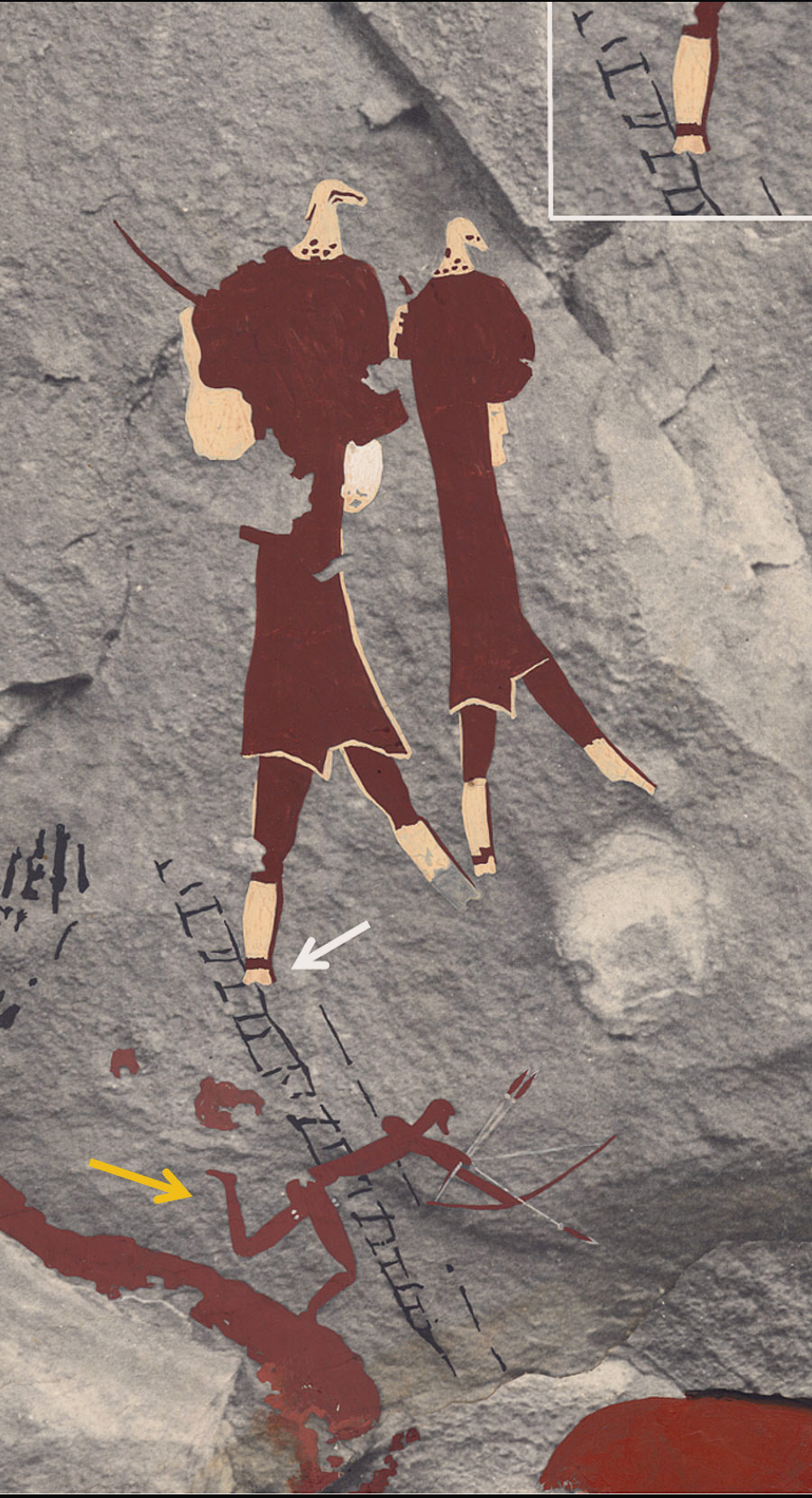
eSibayeni Cave showing running human with bow and arrows (yellow arrow) and the hoof of the therianthrope over the ladder (white arrow, also see inset). Harald Pager redrawing.
Five of the human figures have bags on their backs, while there is a bag alongside another human figure. These bags may have had dual associations: collecting honey and as ‘symbols of transition to the spirit world’ as entering a leather bag was akin to getting into an animal (Lewis-Williams 2003, 22). Carrying bags may also have conveyed ‘good luck and wellbeing’ (Hollmann 2001, 66).
Therianthropes (half-human/half-animal figures) are closely associated with ladders at two sites. At one of these, the hoof of a kaross-clad therianthrope is marginally but deliberately painted over a ladder (Figure 3). Significantly, this therianthrope is taller than the adjacent therianthropes, and its superimposing leg has been painted longer than the other leg, arguably to ensure contact with the ladder, however slight.
Of all the types of animals the hunter-gatherers painted, only eland and rhebuck have been placed over or under ladders (Figure 4 - Figure 5). The significance of eland in hunter-gatherer symbolism is well known. It is believed to contain more potency than any other animal, which medicine people activate in trance. As with eland, rhebuck are believed to hold supernatural power that medicine men tapped into. At one site, two long meandering lines interact with several ladders: one passes over one ladder and the other over two. That these lines superimpose ladders and the other figures is noteworthy as shamans experience meandering lines when entering altered states of consciousness.
No ladders or climbing ropes have been directly dated, but the paintings over and under them provide chronological clues. Especially relevant is a shaded polychrome eland that is under one ladder and over another at the same site (Figure 4). In another instance, a climbing rope is superimposed by an indeterminate shaded polychrome antelope (possibly a rhebuck), while another ladder is superimposed by a shaded polychrome eland. These occurrences suggest that the ladders and climbing ropes are chronologically associated with shaded polychrome imagery that emerged in southern Africa shortly before 2000 years ago.
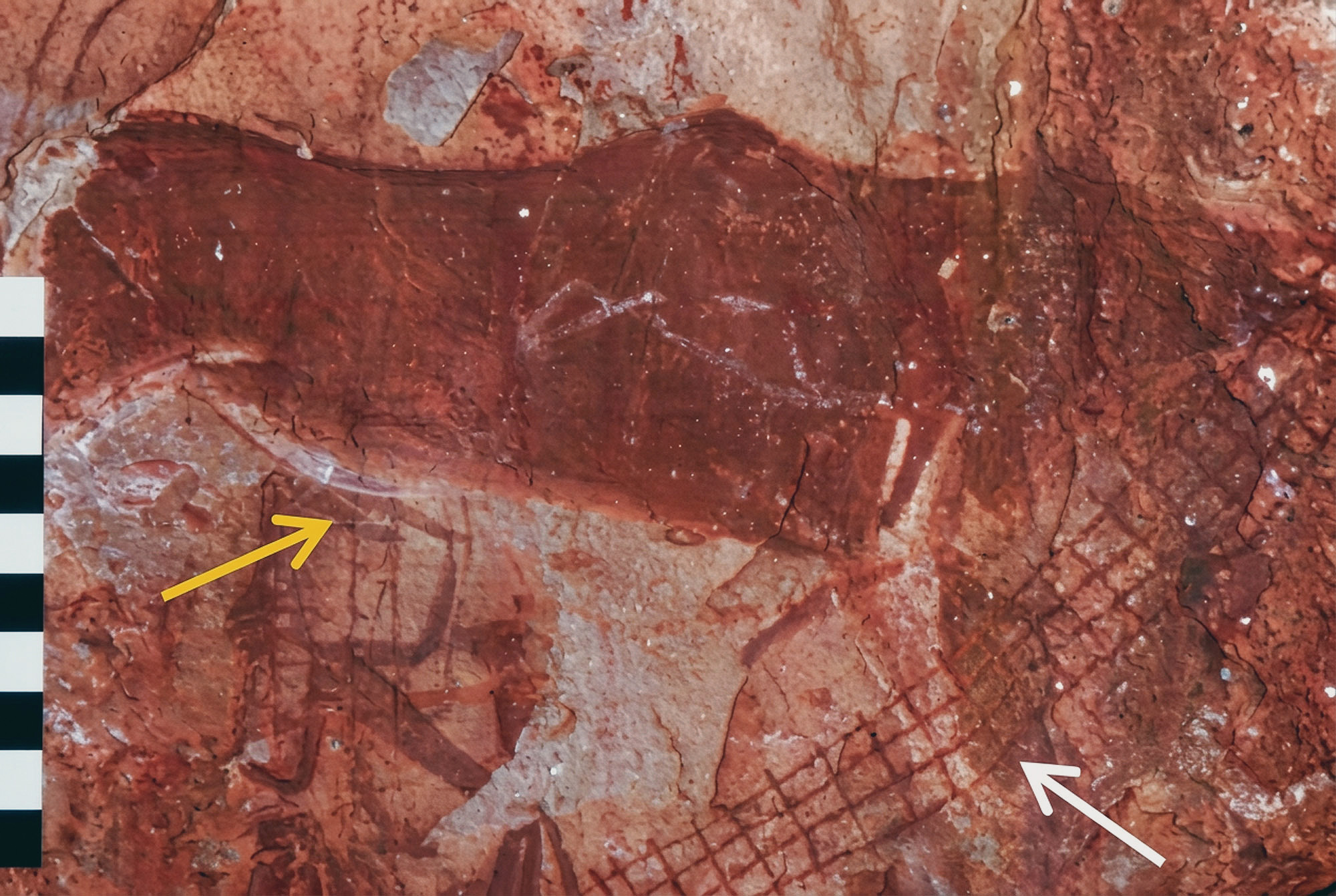
Ladder Shelter using DStretch enhancement showing a shaded polychrome eland over a ladder (yellow arrow) and under another ladder (white arrow).
These renderings of ladders and climbing ropes formed part of a broader suite of hunter-gatherer painting innovations, including a greater variety of subject matter (e.g., felines, otters and ritual figures), shading, and perspective (Figure 6), along with a substantial upsurge in painting.
I have suggested that these changes occurred shortly before 2000 years ago. This is when agriculturist communities were entering southern Africa as well as, possibly, a brief pastoralist presence close to, or even in, the northern uKhahlamba-Drakensberg. The arrival of new populations likely disrupted the socio-economic and mobility networks of hunter-gatherer society, causing heightened stress, which was ameliorated by intensified ritual and painting activity.
There are roughly the same number of ritual paintings in the north and south, but they are more concentrated in the north, particularly in Cathedral (Mazel 1982). In 1982, I suggested these differences might relate to the differing valley configurations in these areas, particularly in Cathedral, where a large central river is joined by tributaries at almost right angles. This created areas where bands may have gathered during ‘an upsurge of ritual activities’ (Mazel 1982, 80) (Figure 2).
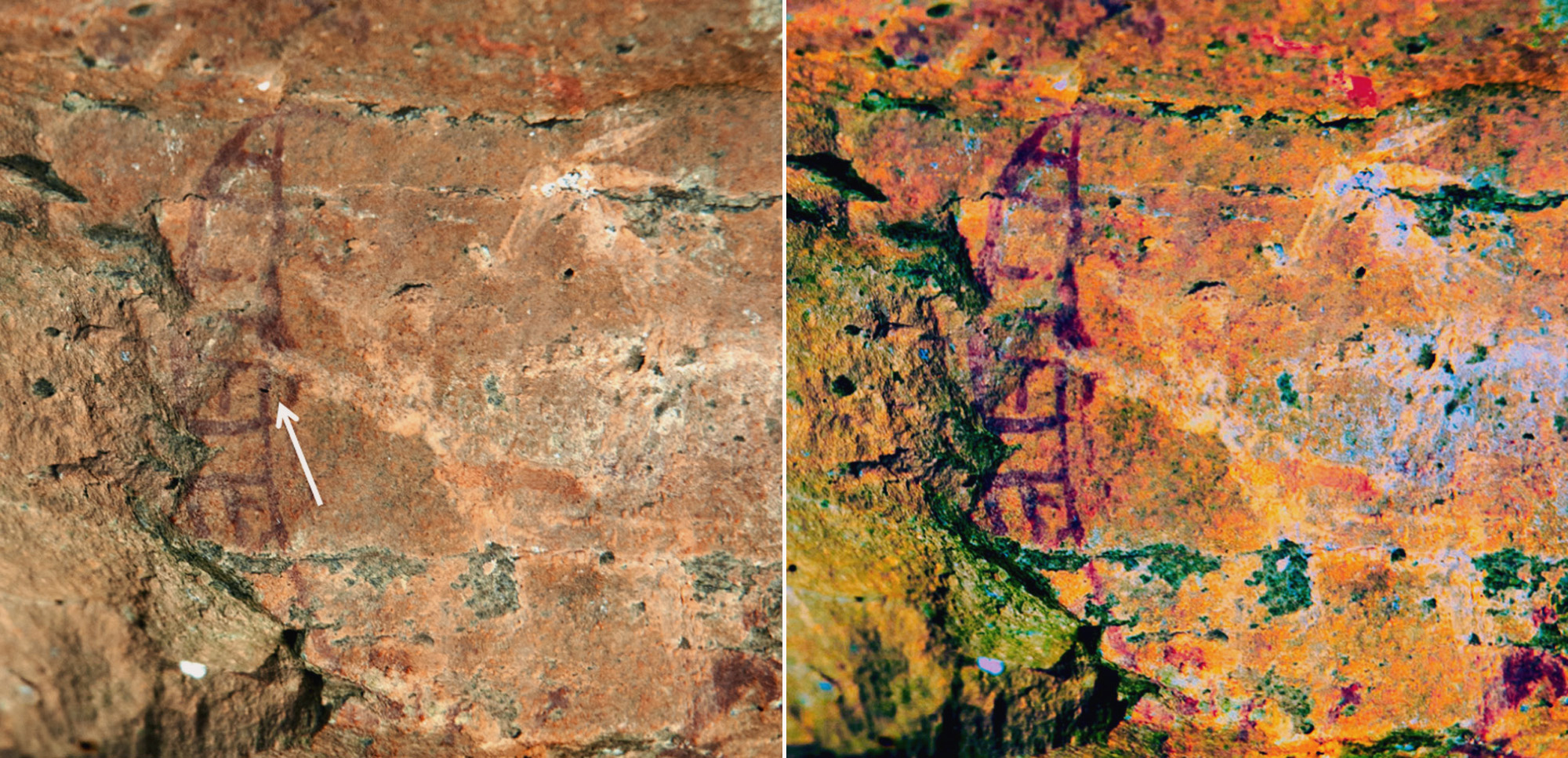
Main Caves North ladder. Original image and DStretch enhancement. White arrow on the original indicates the superimposition of a white rhebuck on a ladder. Note the ladder is associated with a crack in the rockface.
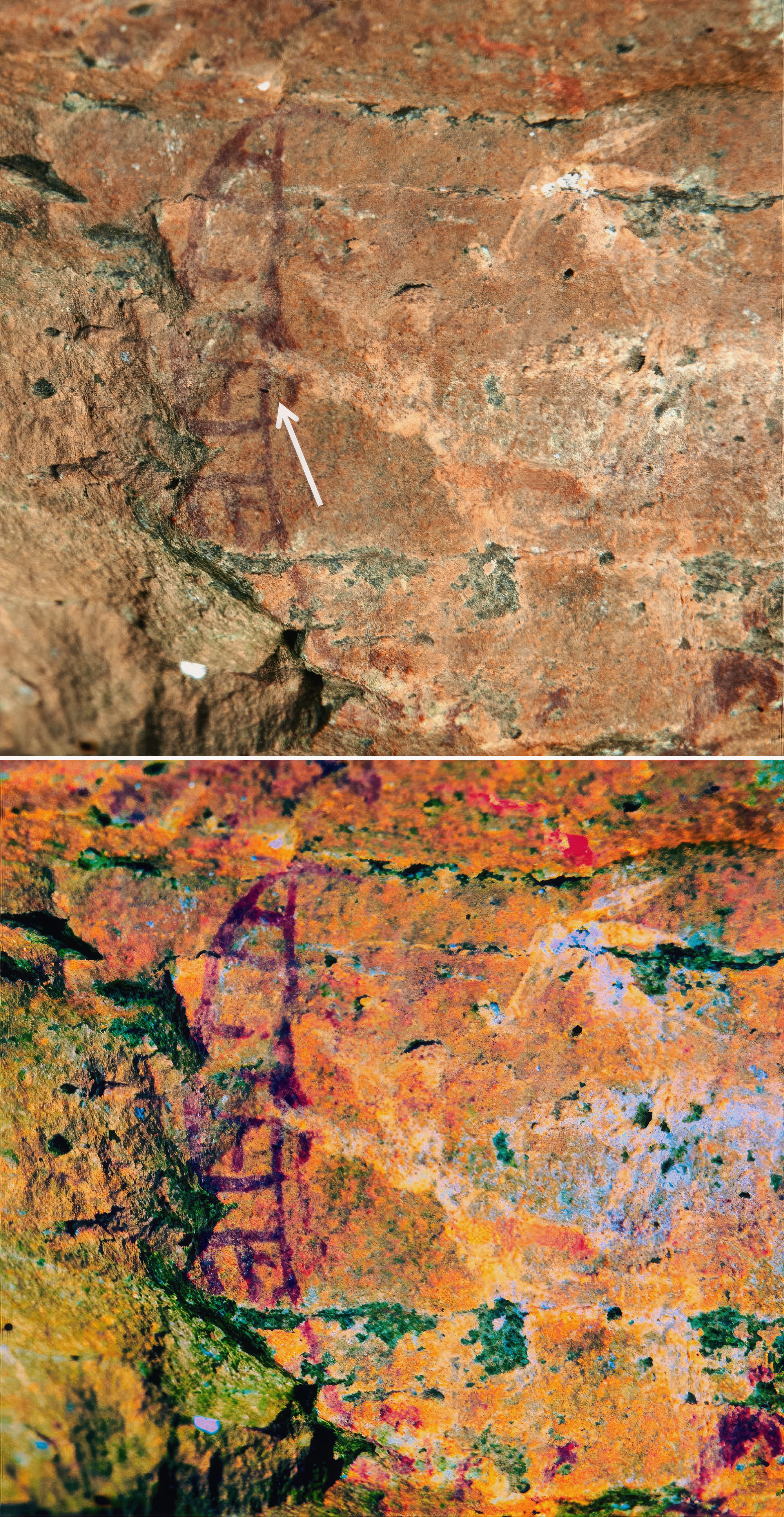
Main Caves North ladder. Original image and DStretch enhancement. White arrow on the original indicates the superimposition of a white rhebuck on a ladder. Note the ladder is associated with a crack in the rockface.
Coupled with this, rock shelter excavations suggest that the hunter-gatherers intensified their settlement of the northern uKhahlamba-Drakensberg, and particularly Cathedral, in the wake of new populations entering southern Africa around 2000 years ago. The attraction of Cathedral to hunter-gatherers may not only have been the meeting places at river junctions, but also the steep-sided and forested Didima Gorge. Pager (1971) believed the gorge, where he documented 3909 paintings in 17 rock shelters, was the richest 5.5 km stretch of rock paintings in South Africa. I have suggested that the exceptional richness of rock paintings in Didima Gorge relates to its extraordinary acoustic properties (Mazel 2011).
The historical context outlined above suggests that the upsurge in hunter-gatherer ritual activities and the increase of painting was accompanied by significant innovation. How, then, do paintings of ladders and climbing ropes fit into this scenario? I propose that the ladder and climbing rope paintings relate to honey collecting. While bees probably occurred in both the northern and southern uKhahlamba-Drakensberg, it is notable that Melin et al.’s (2024) ‘South African bee richness hotspots’ map shows a markedly greater concentration of bees in the north, and this might particularly have been the case in Cathedral.
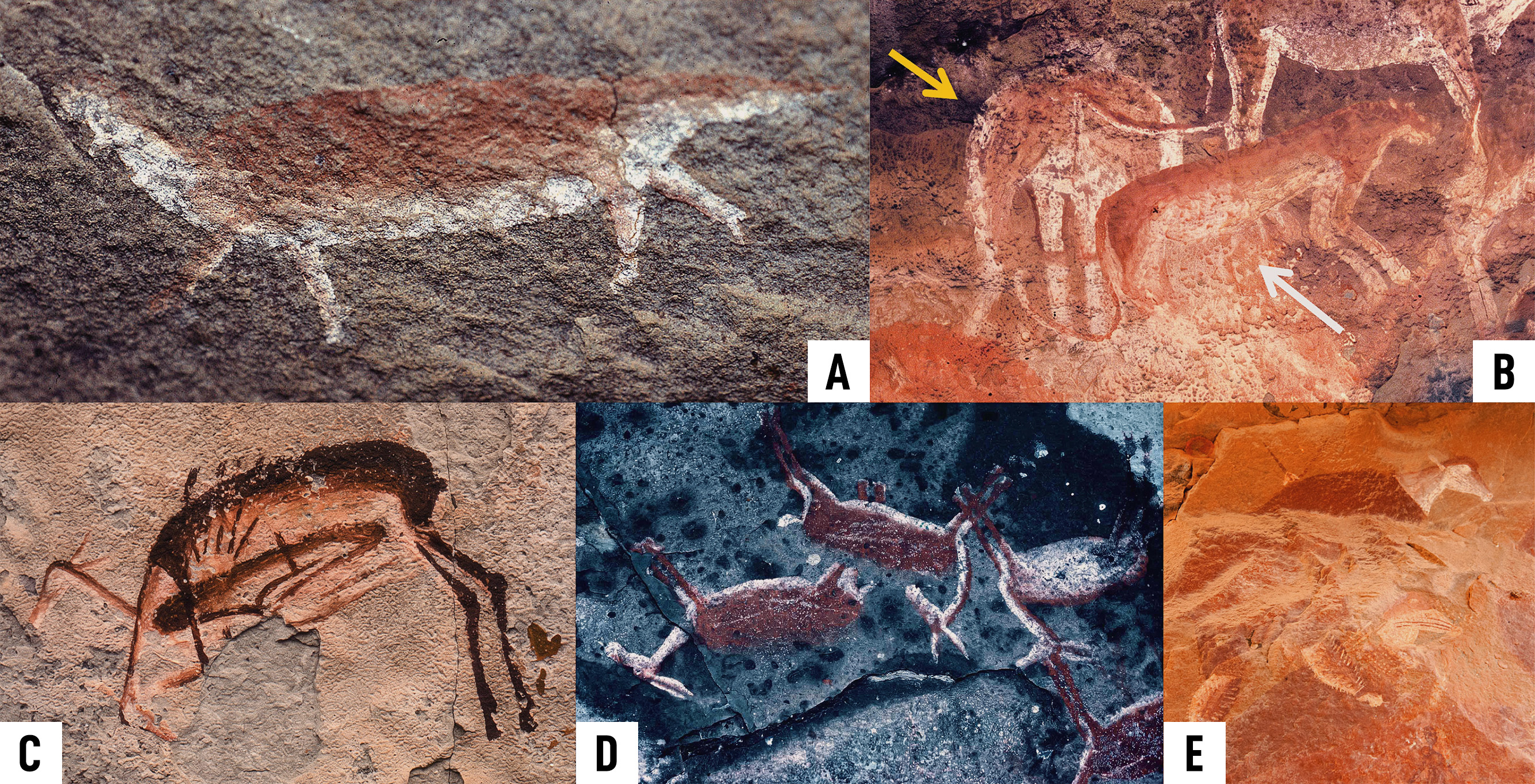
Composite image showing some of the painting innovations around 2000 years ago: a. Main Caves North, shaded otter. Original image and Photoshop enhancement; b. Botha’s Shelter, yellow arrow - foreshortened shaded polychrome eland, white arrow - shaded polychrome feline. Original image and Photoshop enhancement; c. Clarke’s Shelter, two shaded polychrome rhebuck; d. Knuffel’s Shelter, falling shaded polychrome rhebuck. Original image and Photoshop and AI enhancement; e. Eland Cave, two shaded polychrome therianthropes. Original image and Photoshop enhancement.
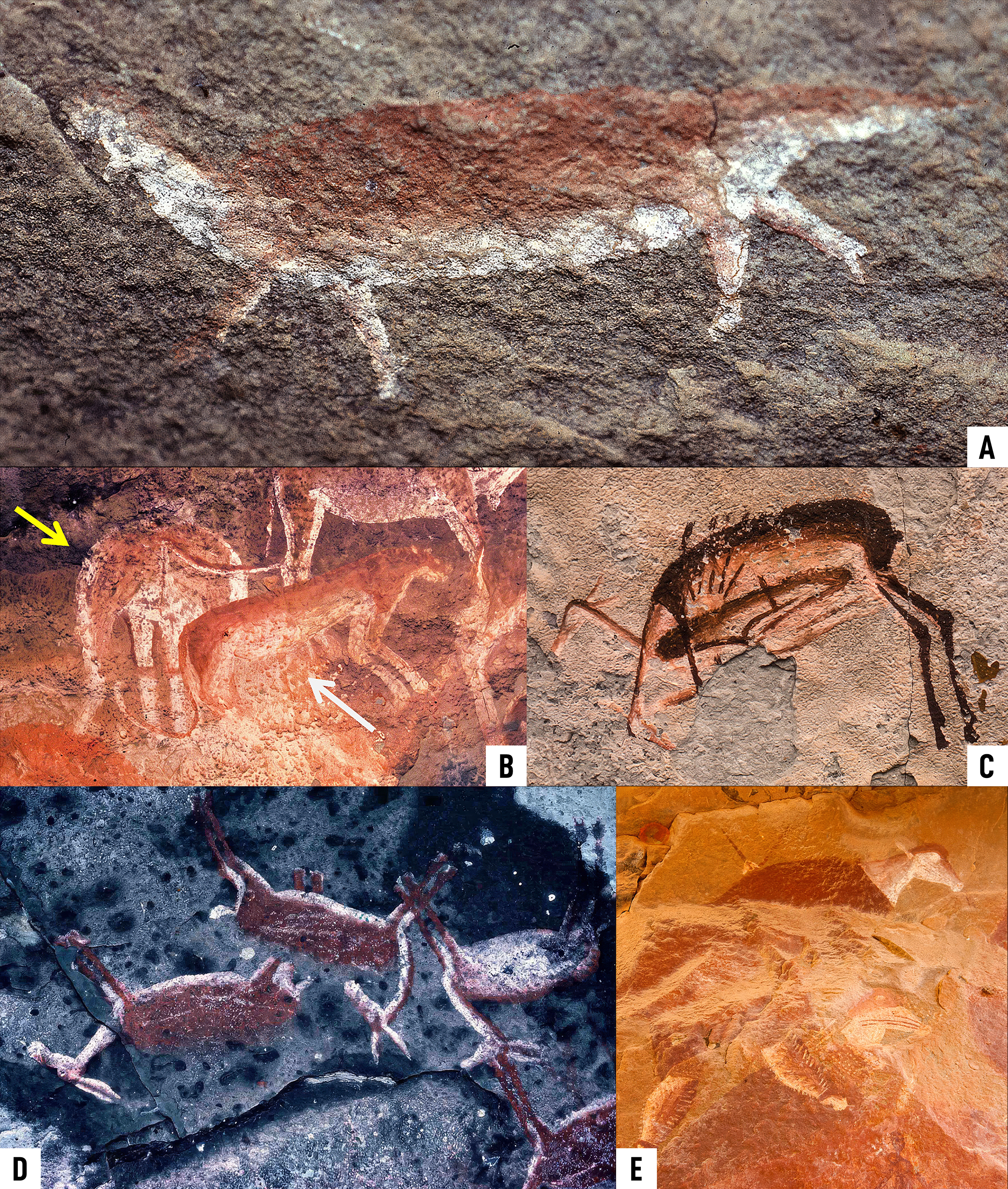
Composite image showing some of the painting innovations around 2000 years ago: a. Main Caves North, shaded otter. Original image and Photoshop enhancement; b. Botha’s Shelter, yellow arrow - foreshortened shaded polychrome eland, white arrow - shaded polychrome feline. Original image and Photoshop enhancement; c. Clarke’s Shelter, two shaded polychrome rhebuck; d. Knuffel’s Shelter, falling shaded polychrome rhebuck. Original image and Photoshop and AI enhancement; e. Eland Cave, two shaded polychrome therianthropes. Original image and Photoshop enhancement.
In conclusion, there were major population changes in southern Africa around 2000 years ago which influenced significant innovations in hunter-gatherer paintings. This included paintings of ladders and climbing ropes in the northern uKhahlamba-Drakensberg, and particularly Cathedral, which, I suggest, owe their existence to hunter-gatherers’ strong desire for honey and the symbolism associated with bees and honey. And these ‘ordinary items of equipment’ were used to obtain them.
My thanks are due to Ann Macdonald for drawing Figure 2 and Justine Wintjes at the KwaZulu-Natal Museum for responding to my numerous requests for site reports.
- Deacon, H. J. 1976. Where hunters gathered: a study of Holocene Stone Age people in the eastern Cape. Claremont: South African Archaeological Society. (Monograph series 1).
- Hollmann, J. C. 2001. “'Big Pictures': Insights into Southern African San Rock Paintings of Ostriches.” South African Archaeological Bulletin 56 (173/174): 62-75. [ Link ]
- Lewis-Williams, J. D. 1986. “Cognitive and Optical Illusions in San Rock Art Research.” Current Anthropology 27 (2): 171-178. [ Link ]
- Lewis-Williams J. D. 2003. “Southern African shamanistic rock art in its social and cognitive contexts.” In “The Archaeology of Shamanism,” edited by N.S. Price. London: Routledge: 17-42.
- Lewis-Williams J. D. and Dowson, T.A. 1990. “Through the Veil: San Rock Paintings and the Rock Face.” South African Archaeological Bulletin 45 (151): 5-16. [ Link ]
- Lewis-Williams, J. D. and Dowson, T. A. 2000. Images of power: understanding Bushman rock art. Johannesburg: Southern Book Publishers.
- Marlowe, F. W., 2010. The Hadza: Hunter-gatherers of Tanzania. Berkeley: University of California Press.
- Mazel, A. D. 1982. “Distribution of painting themes in the Natal Drakensberg.” Annals of the Natal Museum 25: 67-82. [ Link ]
- Mazel, A. D. 2009. “Unsettled times: shaded polychrome paintings and hunter-gatherer history in the southeastern mountains of southern Africa.” Southern African Humanities 21: 85-115. [ Link ]
- Mazel, A. D. 2011. “Time, colour and sound: revisiting the rock art of Didima Gorge, South Africa.” Time and Mind 4: 283-296. [ Link ]
- Melin, A., Beale, C. M., Manning, J. C. and Colville J. F. 2024. “Fine-scale bee species distribution models: Hotspots of richness and endemism in South Africa with species-area comparisons.” Insect Conservation and Diversity 17 (3): 474-487. [ Link ]
- Mguni, S. 2015. Termites of the Gods: San cosmology in southern African rock art. Johannesburg: Wits University Press.
- Pager, H. 1971. Ndedema: a documentation of the rock paintings of the Ndedema Gorge. Graz: Akademische Druck.
- Stow, G. W. 1905. The Native Races of South Africa. London: Swan Sonnenschein.
- Uher, J. 1994. “Zigzag rock art: an ethological perspective.” In “Contested images: diversity in southern African rock art research,” edited by Dowson T.A. and J.D. Lewis-Williams. Johannesburg: Witwatersrand University Press: 293-313.
1 This article is a substantially condensed version of: Mazel, A. D. “Stairways of potency: paintings of ladders and climbing ropes in the uKhahlamba-Drakensberg and adjacent areas, South Africa”. Time and Mind, DOI: 10.1080/1751696X.2026.27430562011.
2 Hereafter, 'ladders' includes possible ladders.
Aron Mazel was a Reader in Heritage Studies in Media, Culture, Heritage at Newcastle University. He retired in 2022 and is currently an Associate Researcher in Archaeology at Newcastle University. Aron had a 25-year career in archaeological research and heritage and museum management in South Africa (SA) before moving to the United Kingdom (UK) in 2002. Management posts he has held include Assistant Director of the Natal Museum (1994-1997), Director of the South African Cultural History Museum (1998-2002), and Director of the International Centre for Cultural and Heritage Studies, Newcastle University (2012-2015). His publications have comprised archaeological investigations, including rock-art; museum and archaeology histories; digital heritage; and the safeguarding and interpretation of tangible and intangible cultural heritage.
In terms of rock art, Aron has done extensive recording of rock paintings in the uKhahlamba-Drakensberg (South Africa) and carved panels in Northumberland (UK). His rock-art publications have included the management and public presentation of rock art, the distribution of different painted themes, the role of acoustics in the location of rock-art, domestic animals in rock-art, animal seasonality, colonial rock-art, chronology and dating, and integrating rock-art with excavation datasets to improve our understanding of hunter-gatherer history.
- A Painted Treasure - San hunter-gatherer visual engagement with Didima Gorge
- Beginning of a Rock Art Journey - Recording Paintings in the uKhahlamba-Drakensberg 1979 - 1980
- Reflecting on the abundance of sheep and baboon paintings in Junction Shelter, Didima Gorge, South Africa
- Sigubudu: Paintings of people with guns in the northern uKhahlamba-Drakensberg
- Animals in Rock Art
- San rock art exhibition at the National Museum & Research Center of Altamira
- The Rock Art of South Africa
- South Africa Rock Art Gallery
- San Rock Art of the Drakensberg
- RARI - Rock Art Research Institute
- ARADA - African Rock Art Digital Archive (formerly SARADA)
- SARAP - Southern African Rock Art Project
- A Map from the Memory of the World
- Early masterpieces: San hunter-gatherer shaded paintings of the uKhahlamba-Drakensberg and surrounding areas
- Africa's World Heritage Sites
- Explore Cederberg Rock Art
- A Painted Treasure - San hunter-gatherer visual engagement with Didima Gorge, South Africa
- Beginning of a Rock Art Journey - Recording Paintings in the uKhahlamba-Drakensberg 1979 - 1980
- Post-Traumatic Stress Disorder (PTSD) and forager theories of disease in nineteenth century southern Africa, and its implications for understanding images of conflict in San rock art
- Reflecting on the abundance of sheep and baboon paintings in Junction Shelter, Didima Gorge, South Africa
- History debunked: Endeavours in rewriting the San past from the Indigenous rock art archive
- Art and Influence, Presence and Navigation in Southern African Forager Landscapes
- Markwe Cave, Zimbabwe
- Escaped slaves, rock art and resistance in the Cape Colony, South Africa
- Sigubudu: Paintings of people with guns in the northern uKhahlamba-Drakensberg
- Glimpses of Stone Age ‘workshops’ - archaeologists shed light on hunter-gatherer toolmaking
- Origins Centre - A Museum in Africa for the People of the World
- Animals in Rock Art
- Rock Art of Ukhahlamba-Drakensberg - San rock art exhibition at the National Museum & Research Center of Altamira
- Reflecting Back: 40 Years Since ‘A Survey of the Rock Art in the Natal Drakensberg’ Project (1978-1981)
- Interview with Dr Ben Smith